Regional operator — core network modernisation
Replacement of the core network and backup power at fourteen points of presence, with no commercial service outage.
- Reference
- KP-2023-021
- Sector
- Telecommunications
- Country
- Mali
- Year
- 2023
- Duration
- 14 months
Modernising without cutting service, schematic
- 01Network in service
- The existing network keeps carrying commercial traffic throughout the works. It is never stopped in order to be replaced.
- 02Second core built
- The replacement core is built alongside, on a site away from the first, and proven outside production.
- 03Batched cutover
- Points of presence move in groups, each reversible. A batch that behaves badly returns to the old core without waiting for the next.
- 04Modernised network
- Two redundant cores on separate sites, duplicated collection, management traffic prioritised and kept apart from customer traffic.
- 05Load balance
- Measured site by site. It is this, not installed capacity, that says what the backup power has to hold.
- 06Power per site
- Every point of presence gets its own reserve. A redundant core on a site without power is not redundant.
- 07Supervision
- The state of every link and every site, before, during and after the cutover. It is what makes a rollback decidable.
01
The context
The core network ran on equipment whose vendor support had ended, and whose configuration was documented nowhere. Two of the fourteen points of presence had no electrical autonomy left: a public grid outage caused an immediate interruption there. The operator could tolerate no commercial outage window longer than a few minutes.
02
The mission
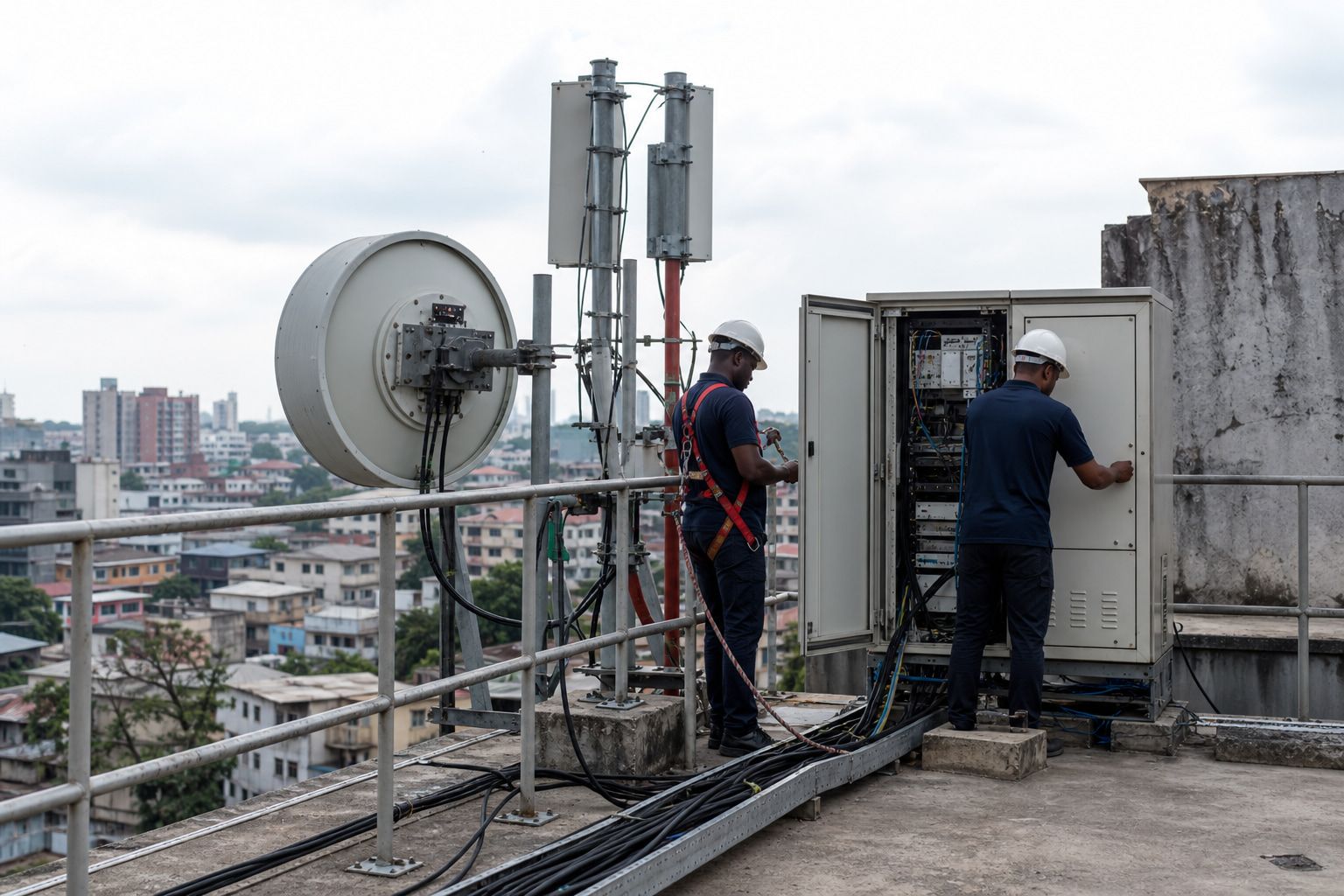
Map the existing estate, rebuild a documented architecture, then migrate the fourteen points of presence in batches, keeping service running at each step. In parallel, restore backup power at the sites that lacked it.
03
The architecture
Two redundant cores at separate sites, duplicated collection paths, management traffic prioritised separately from customer traffic. Backup power sized per point of presence on the measured load balance, not on installed capacity.
04
Delivery
Mapping preceded any equipment order: three months of on-site survey, device by device, capturing the actual configuration rather than the one on the original diagram. Migrations were carried out at night, in batches of two points of presence, with a fallback prepared and tested before each cutover.
05
Results
A documented architecture, operated by the operator's own teams. The two points of presence without autonomy now have a load-tested replacement source, and the whole is supervised from a single position.
06
What we take from it
On a legacy network, the field survey costs three months and saves a year. The actual configuration always differs from the diagram, and it is the gap between them that produces migration incidents.
Results
- 14
- Points of presence migrated
- 4 min
- Longest outage window observed
- 14
- Months of programme
Technologies
- Cisco
- MikroTik
- Zabbix
- Grafana
- Cummins
Solutions concerned
Why some clients are not named here
We design security systems and information systems for organisations whose public exposure is an operational risk. The discretion we apply to their projects is the discretion we will apply to yours. Identities, architectures and contractual documents are shared with an identified organisation as part of a pre-qualification.