Mining site — server room and backup power
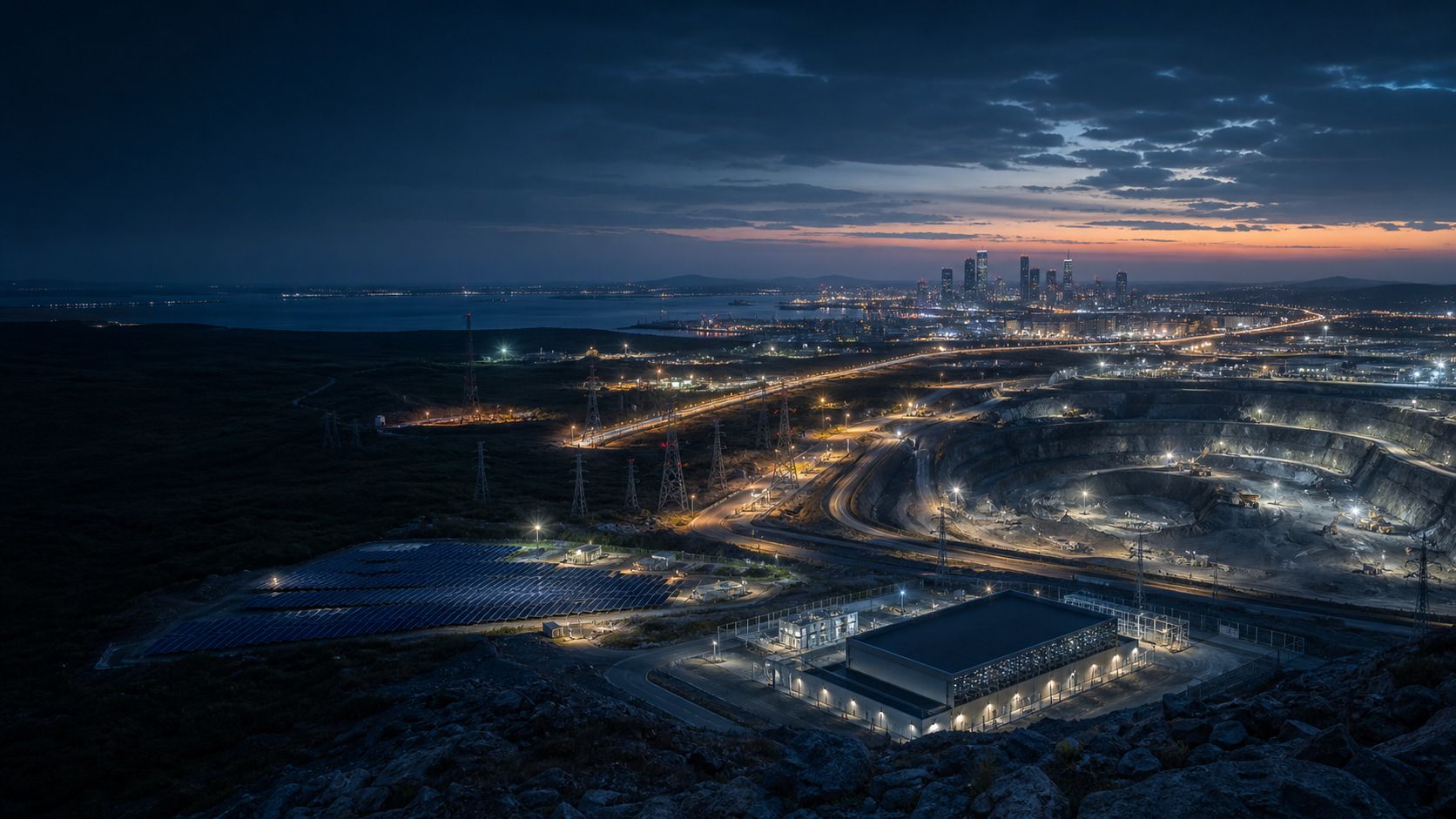
Construction of a secure technical room and its power chain, on an isolated site with no reliable public grid.
- Reference
- KP-2024-008
- Sector
- Energy and critical infrastructure
- Country
- Mali
- Year
- 2024
- Duration
- 7 months
From source to load, schematic
- 01Public grid
- Normal source. Its availability is measured before it is assumed: it governs everything sized downstream.
- 02Generator set
- Replacement source. It is sized on the measured load balance, never on the sum of the nameplates.
- 03Automatic transfer
- Switches between the two sources. The time it takes is the window the next stage has to cover.
- 04Main board
- Separates what cannot stop from what can wait. That separation is worth more than the capacity added.
- 05UPS
- Covers the generator start-up window on the critical loads alone. Its autonomy follows from that window.
- 06Critical loads
- Server room, security, transmissions. What sits here decides the size of everything upstream of it.
- 07Sheddable loads
- Workshops, comfort, deferrable uses. Shedding them at the right moment avoids paying twice over for a generator.
- 08Supervision and tests
- Grid presence, source state, fuel level, engine hours. What is not measured cannot be attributed to a cause.
01
The context
Operations depended on an improvised room: domestic air conditioning, cabling reworked several times, no fire detection, and a supply shared with the workshops. Two production stoppages had already been caused by a power failure, without the exact cause being established for lack of measurement.
02
The mission
Design and build a dedicated technical room, with its cooling, detection, access control and full power chain, then maintain it under contract.
03
The architecture
The public grid and the generator converge on an automatic transfer switch, then on a main board that separates critical from sheddable loads. Critical loads pass through a UPS covering the generator start-up window. Every stage reports to supervision: grid presence, source state, fuel level, engine hours.
04
Delivery
The load balance was measured over four weeks of actual operation rather than estimated from nameplates. It revealed enough growth allowance for two extensions, and ruled out a larger sizing that would have run the generator far below its efficiency range.
05
Results
Operations now have a room with controlled conditions, a replacement source load-tested every month, and measurement that allows an outage to be attributed to its cause. The maintenance contract covers periodic testing and consumable replacement.
06
What we take from it
A measured load balance costs four weeks and changes the sizing. Estimated from nameplates, it almost always leads to oversizing, which degrades both the generator's efficiency and its life expectancy.
Results
- 4
- Weeks of measurement before sizing
- 12
- Load tests per year
- 7
- Months on site
Technologies
- Perkins
- Deep Sea Electronics
- Socomec
- APC
- Zabbix
Solutions concerned
Why some clients are not named here
We design security systems and information systems for organisations whose public exposure is an operational risk. The discretion we apply to their projects is the discretion we will apply to yours. Identities, architectures and contractual documents are shared with an identified organisation as part of a pre-qualification.