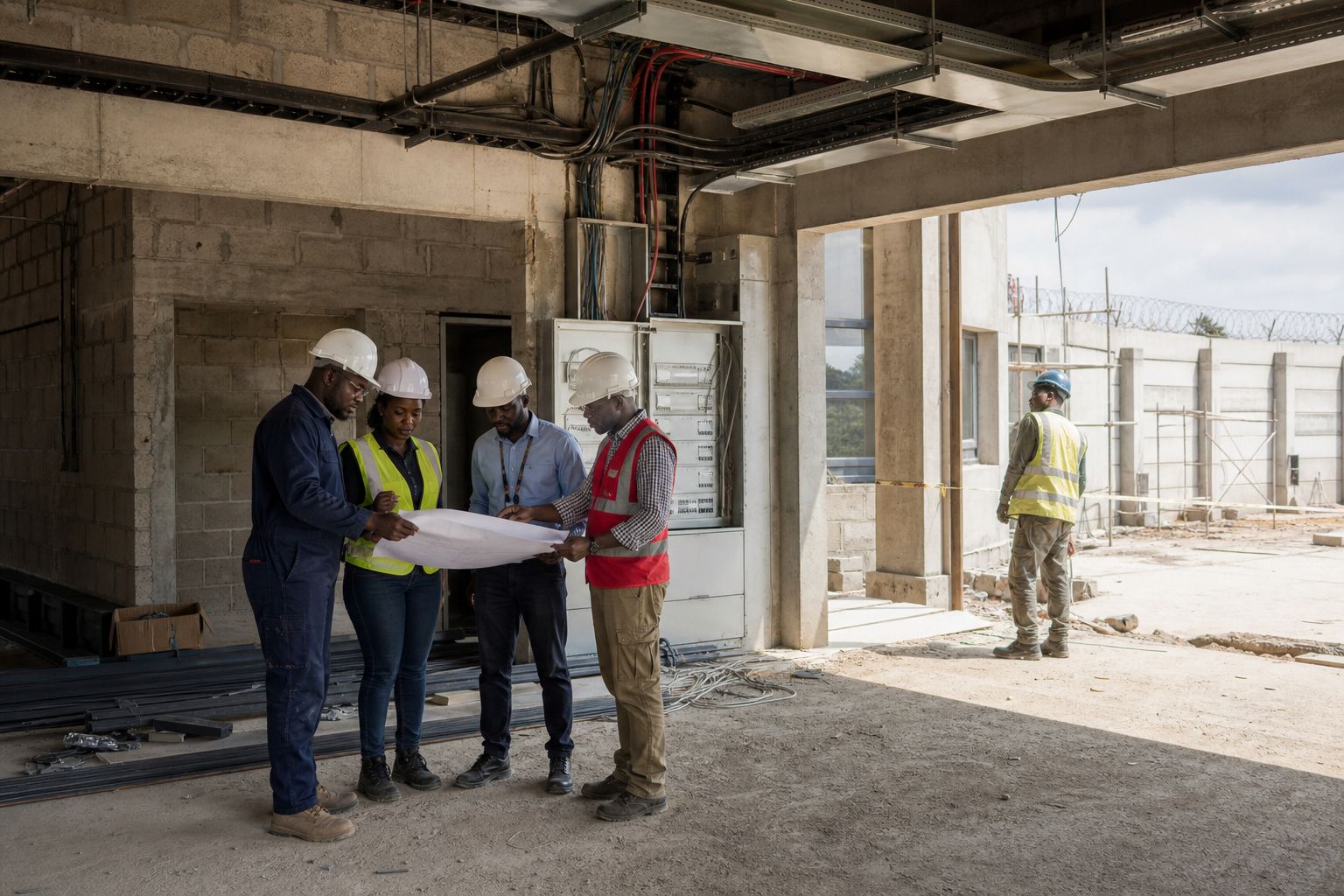
European diplomatic mission — multi-system security
Complete overhaul of access control, video surveillance and backup power for a chancery in service.
- Systems merged
- 3
- Service interruptions
- 0
Reference KP-2022-014
A camera is worth nothing until someone has decided what its footage is for.
The problem
A video surveillance tender almost always opens with a number. Thirty cameras, sixty, a hundred and twenty. That number is the outcome of a calculation nobody performed: it comes from an earlier quotation, an annotated site plan, or the available budget.
The useful question lies elsewhere. At every point of the site, it must be decided whether the image has to support detecting a presence, recognising someone already known or identifying an unknown face. These three uses call for different pixel densities on target, different optics, different camera positions and different lighting.
A system designed for detection and used for identification produces unusable footage at the moment it matters. The defect does not appear at acceptance: it appears on the day of the incident, when the recording is retrieved and proves nothing.
From intended use to evidence, schematic
Scope
Situations
Requirements
These requirements hold whichever supplier is appointed. Written into a tender, they filter out the responses that will not hold.
Pitfalls
Questions
The question cannot be answered as a number. It is answered zone by zone, by deciding whether the image must support detection, recognition or identification. An identification zone demands a far higher pixel density on target than a detection zone, and therefore more cameras or different optics. The number is the result of that study, never its starting point.
It follows from how long it typically takes for an incident to be noticed and reported, and from the rules applying to the site. A period chosen without that reasoning is either too short to be useful or too long to be justified. It drives the storage volume directly, and must be contracted against the real bitrate of the streams, not a theoretical one.
Separation is required, but it can be logical rather than physical. What matters is that video traffic does not degrade other uses, that cameras are not reachable from the office network, and that compromising one camera opens no path into the rest of the system.
No. It reduces the volume to be watched by flagging events, which helps when the number of streams exceeds what an operator can follow. It produces false alarms, at a rate that depends on tuning and on the scene. Analytics commissioned without on-site tuning and without several day-night cycles of observation is abandoned by operators within weeks.
Video surveillance loses its purpose at the very moment the power fails. Cameras, the switches that power them, the recording and the viewing station must be backed up together; backing up cameras without backing up the recorder retains no footage at all.
Often. A coverage audit shows which cameras serve their intended use and which do not. The upgrade then touches a few viewpoints, the recording or the network, rather than the whole. A full replacement is justified when the cabling or the power supply can no longer carry the intended system.
Evidence
Complete overhaul of access control, video surveillance and backup power for a chancery in service.
Reference KP-2022-014

A single control room for six sites whose security systems did not talk to each other.
Reference KP-2025-002
Situations that lead here
Solutions concerned
Consultations · Pre-qualifications · Partnerships
Describe the site, the dominant constraint and the deadline. We will say what requires a preliminary study and what can be committed directly.
Results
No result.Try a broader word: power, security, network, pre-qualification.
↑↓ Move↵ Open pageEsc CloseAll pages